Your foot is important. It is your base of support. It must be stable enough to support the joints above and transmit force, yet mobile enough to adapt to the ground and provide shock absorption. In my practice I see a lot of people with foot pain and a lot of dysfunctional feet. I don’t see many efficient feet. We, as a culture, do not take good care of our feet. As a consequence we suffer from preventable pain and mobility deficits throughout our bodies. In my practice I apply functional manual therapy techniques to improve mobility and stability of the foot and the whole body. I also educate and coach my patients in exercises and habits that will assist in healing and prevent recurrence of their pain. The following three pieces of advice are the most frequent ‘quick fixes’ that I prescribe for foot pain. Apply these and you will improve your balance and strength, and decrease pain from head to toe.
Stand with the weight in the middle of your foot
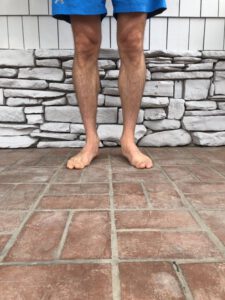
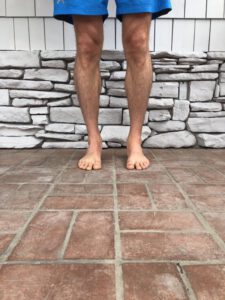
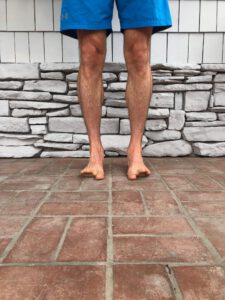
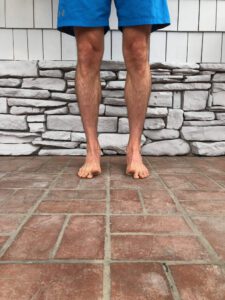
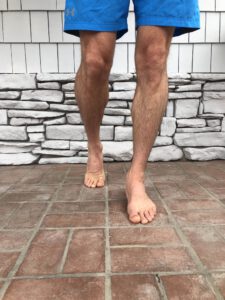
Inefficient Foot PostureEfficient Foot Posture
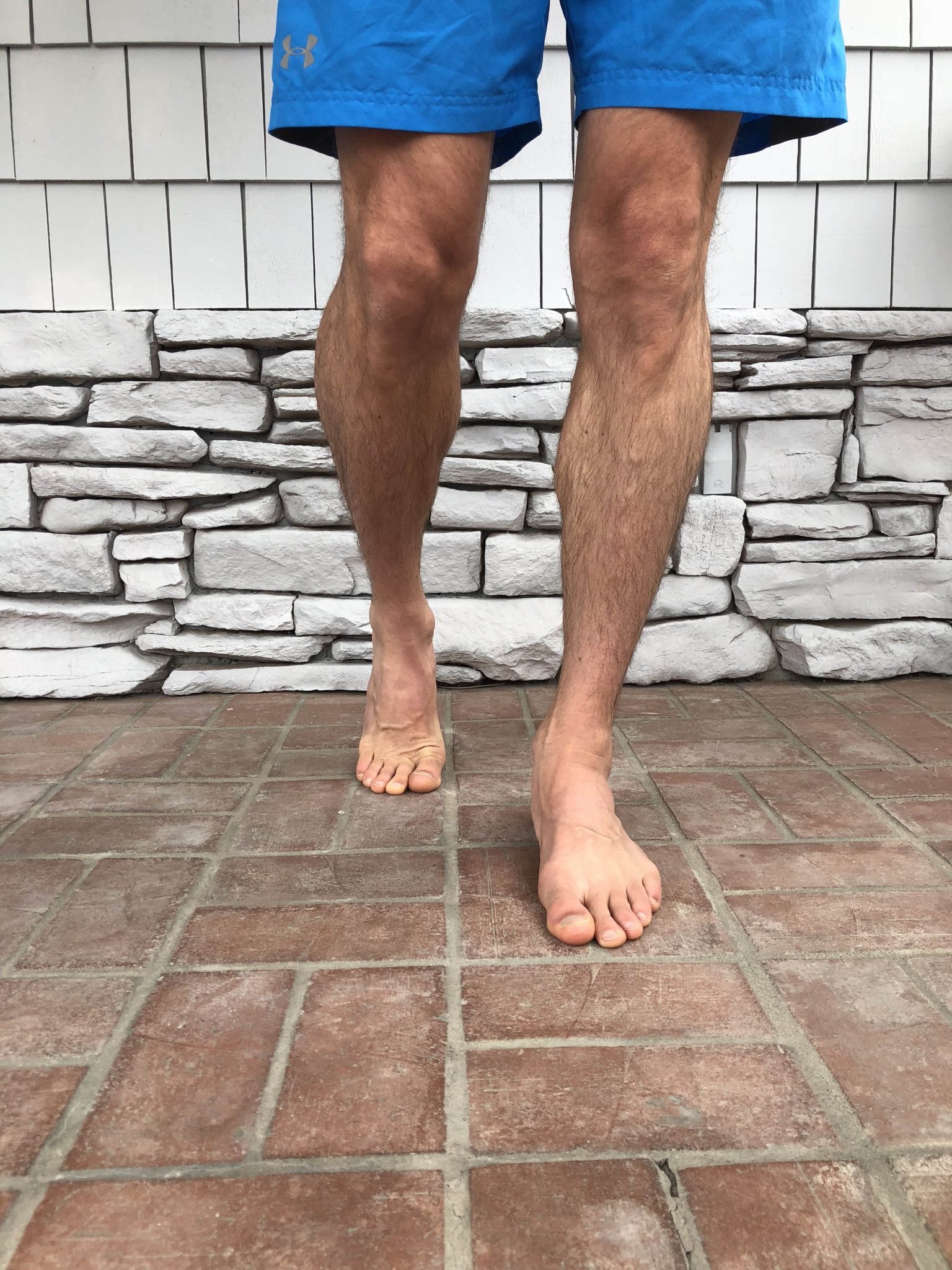
Most people stand with their weight in the heels and their feet turned out. This inhibits the foot musculature, reduces shock absorption through the system, and can lead to foot pain. This position of the feet biases the knees into hyperextension, rotates the pelvis forward, and puts strain on the lower back.
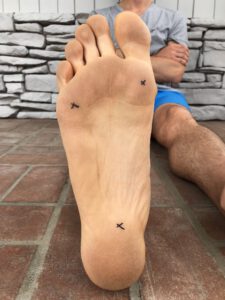
Foot Tripod
During normal standing the body weight should be distributed equally between the heel and the toes, and between the inside and outside of the foot. Essentially, weight should be distributed equally between the front of the heel, the base of the big toe, and the base of the little toe.
This is your foot tripod! When standing you should feel equal weight through each point. For most people this brings their entire body forward over the foot. This will engage the muscles of your foot and provide a softer base of support with more shock absorption through your entire body. This also puts you into a position that can better anticipate movement and loading.
Strengthen your ‘foot core’
The foot core is comprised of three subsystems:
-Passive subsystem: the plantar fascia and various plantar ligaments.
-Active subsystem: the muscles and tendons of the foot.
-Neural subsystem: the nerves, sensory receptors in the joint capsules, ligaments, muscles, and tendons.
By definition we do not have direct control over our passivesubsystem. However, the strain placed on these passive structures such as the plantar fascia is dependent upon factors such as the strength of the foot musculature and habits of foot posture. Research has consistently shown decreased size/strength of the intrinsic muscles of the foot in patients with foot pain due to plantar fasciitis / plantar fasciopathy. A critical component of the active subsystem, the intrinsic muscles are a group of 11 muscles that begin and end in the foot. They help to maintain stiffness of the arch as well as providing important neural feedback for adapting the foot to the ground. This neural feedback makes these muscles very important as part of the neural subsystem as well. To our detriment, these muscles are under-utilized and too weak.
Three Exercises to Strengthen the intrinsic muscles of your foot and stop foot pain
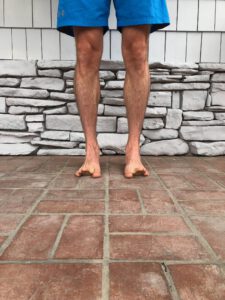
Stand with both feet on the ground and weight distributed equally – ‘foot tripod’. Lift all toes and feel how this lifts your arch – maintain the ‘foot tripod’. Without curling your toes, lower them back to the surface.
Little Toe Isolation
1) Little Toe Isolation – Push your big toe into the ground. Maintain pressure down with the big toe as you lift the other 4 toes up towards the ceiling. Hold for 30 seconds, then repeatedly lower and lift the 4 little toes 15 times, maintaining big toe contact with the ground the entire time.
Big Toe Isolation
2) Big Toe Isolation – Push your 4 little toes into the ground. Maintain pressure down with the little toes as you lift the big toe up towards the ceiling. Hold for 30 seconds, then repeatedly lower and lift big toe 15 times, maintaining ground contact with the 4 little toes the entire time.
Toe Spread Out
3) Toe Spread Out – Stand with both feet on the ground and weight distributed equally – ‘foot tripod’. Lift all toes and feel how this lifts your arch – maintain the ‘foot tripod’. Without curling your toes, attempt to spread the toes as much as possible, reaching to the ground with the big and little toes. Toes 2-4 should not rest on the ground. Hold for 30-60 seconds. Repeat 3 times.
Perform these exercises every day to see best results.
Push off of the middle of your foot when you walk
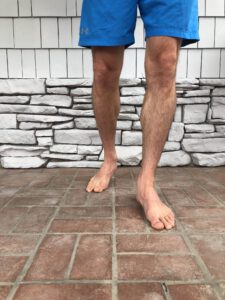
As I mentioned before, most people stand with their foot in too much external rotation – ‘turn out’. This is also a problem during walking. This leads to excessive pressure on the base of the big toe during push-off/propulsion, excessive pronation through the back of the foot at the ankle, and excessive rotatory compensation through the knee, hip, and into the spine. If you notice a callous on the skin around the big toe, or have a bunion or hallux valgus deformity, this is especially true for you.
Inefficient Push-off
When you walk, your body weight should transition from the front of the heel all the way through the toes, with an emphasis on the 2nd toe. Allowing your toes to extend reinforces stability of the arch of the foot, minimizes rear-foot pronation during push-off, and ultimately provides a stronger foot structure.
Efficient Push-off
References
-Kim MH et al. Comparison of muscle activities of abductor hallucis and adductor hallucis between the short foot and toe-spread-out exercises in subjects with mild hallux valgus. Journal of Back and Musculoskeletal Rehabilitation 26 (2013) 163–168.
-McKeon PO, Hertel J, Bramble D, Davis I. The Foot Core System: a new paradigm for understanding intrinsic foot muscle function. Br J Sports Med Published Online First doi:10.1136/bjsports-2013- 092690
-Wearing SC, Smeathers JE, Urry SR, et al. The pathomechanics of plantar fasciitis. Sports Med 2006;36:585–611.
An Introduction Kinesio tape, first introduced to the world during the 1988 Summer Olympics, has steadily gained popularity over the years. Its initial introduction to the U.S. occurred in March 1995 in Portland, Oregon, at the Northwest Athletic Trainers Association Annual Clinical Symposium. Although it began as a relatively niche tool, the 2008 and 2012…
[vc_row][vc_column][vc_column_text]I’m excited for Dec 21st. It’s the winter solstice, and it’s just 5 days away. That means the days will start to get longer! Here in the Pacific Northwest, winter hits me hard; the rain and the shorter days have a significant impact on my overall well being, and my mental health as a result….
What is Laser Therapy? Low level laser therapy is a technology that uses a combination of light emitting diodes (LEDs) and lasers diodes to bathe diseased or traumatized tissues with photons. These particles of energy are selectively absorbed by the cells in your body resulting in a cascade of reactions leading to the restoration of normal…
Our spinal column serves to protect our nervous system and is an attachment site for the muscles, ligaments, nerves, guts and fascia, it stores kinetic energy and it helps transfer the loads of the body into our base of support. To function effectively, the spinal column needs to be both stiff and flexible at the same time. This dynamic dance of stiffness and flexibility is orchestrated by the brain’s incredible ability to control a symphony of muscles around the spine.
We need to know your story to quickly and effectively get to the root cause of your symptoms. Following this guide will help us understand exactly what is going on in your current presentation.
Though conventional rehabilitation traditionally focuses solely on treating the shoulder complex, this joint is more often the victim than the culprit.