
Fascia and Training – The Best Way to Improve Mobility
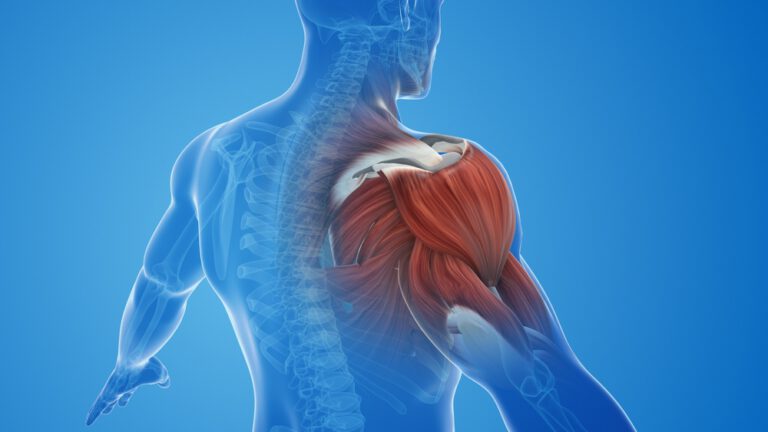
I’ve heard fascia described in many ways, ranging from, ‘’The white stuff on a chicken’, to ‘a body wide tensional network, which consists of all fibrous collagenous soft tissues, whose fibrous architecture is dominantly shaped by tensional strain rather than compression’ (that’s a mouthful!) Fascia is connective tissue – it literally connects and holds together everything under the skin. It consists primarily of collagen fibers, elastin fibers, and water. Two-thirds of fascia is actually water.
Fascia can be subcategorized as superficial, deep, and epimyseal:
 Stretch in ways that emphasizes fascial chains (larger movements), not isolated muscles. And variety of motion is key. Many yoga poses incorporate this concept. For example, the Trikonasana (‘Triangle Pose’) incorporates a complex movement that challenges numerous fascial chains.
*There are times, in rehabilitation for example, where isolation is appropriate.
Vary your stretching regimen to incorporate both static and dynamic stretching. There are benefits to both types. Static stretching (holding a position for 60-90 seconds) can decrease inflammation and pain in inflamed tissues. Dynamic stretching incorporates movement while stretching, at various magnitudes and speeds. This can enhance the mobility and elasticity of the fascial layers. An example of this is bouncing on your toes or alternating bending / straightening your knees while in the ‘downward dog’ position in yoga.
Stretch in ways that emphasizes fascial chains (larger movements), not isolated muscles. And variety of motion is key. Many yoga poses incorporate this concept. For example, the Trikonasana (‘Triangle Pose’) incorporates a complex movement that challenges numerous fascial chains.
*There are times, in rehabilitation for example, where isolation is appropriate.
Vary your stretching regimen to incorporate both static and dynamic stretching. There are benefits to both types. Static stretching (holding a position for 60-90 seconds) can decrease inflammation and pain in inflamed tissues. Dynamic stretching incorporates movement while stretching, at various magnitudes and speeds. This can enhance the mobility and elasticity of the fascial layers. An example of this is bouncing on your toes or alternating bending / straightening your knees while in the ‘downward dog’ position in yoga.
 Incorporate muscle contractions into your stretches. ‘Contract-relax’ is a PNF (Proprioceptive Neuromuscular Facilitation) technique that alternates a stretching phase (relax) and a contraction phase (contract). Typically one holds a stretch for 10-15 seconds, then performs an isometric contraction (no movement) of the muscles being stretched for 5 seconds, and then repeats this process 3-4 times.
2) Mobilize appropriately using foam rollers or mobilization balls:
When using a self-mobilization tool such as a foam roller, move slow and don’t rush. Take the IT Band as an example – as you maintain pressure on a tender point, try small movements such as bending/straightening your knee to enhance mobility in the location of compression (yes, this hurts). After about 15-30 seconds, move on to another location. Think of your fascia like a sponge. As you apply compression you are driving fluid out of the tissues in the region where pressure is applied. When you release the pressure, fresh fluid (blood, metabolites, etc…) enters the tissues, which rehydrates the tissues. Vibrating foam rollers (we like Hyperice – https://hyperice.com/) provide the added benefit of increasing tissue temperature and increasing proprioceptive feedback to the tissues (fascia LOVES this).
3) Be elastic. Healthy fascia is springy:
To improve the elastic recoil and force transmission capabilities of your fascia, start with incorporating small, controlled bounces during stretching. Progress to incorporating various plyometric-type movements, such as jump rope, hops, or squat jumps, or light plyometric wall-pushups for the upper body.
Fascia is extremely adaptable and constantly remodeling. All of the fascia in your body is replaced about every 2 years. Applying these principles to your training will benefit your mobility and strength in the long run.
REFERENCES:
Schleip R and Muller DG. Training Principles for Fascial Connective Tissues: Scientific Foundation and Suggested Practical Applications. Journal of Bodywork and Movement Therapies (2012), http://dx.doi.org/10.1016/j.jbmt.2012.06.007
Stecco A, et al. Fascial Disorders: Implications for Treatment. American Academy of Physical Medicine and Rehabilitation (2015), http://dx.doi.org/10.1016/j.pmrj.2015.06.006
Incorporate muscle contractions into your stretches. ‘Contract-relax’ is a PNF (Proprioceptive Neuromuscular Facilitation) technique that alternates a stretching phase (relax) and a contraction phase (contract). Typically one holds a stretch for 10-15 seconds, then performs an isometric contraction (no movement) of the muscles being stretched for 5 seconds, and then repeats this process 3-4 times.
2) Mobilize appropriately using foam rollers or mobilization balls:
When using a self-mobilization tool such as a foam roller, move slow and don’t rush. Take the IT Band as an example – as you maintain pressure on a tender point, try small movements such as bending/straightening your knee to enhance mobility in the location of compression (yes, this hurts). After about 15-30 seconds, move on to another location. Think of your fascia like a sponge. As you apply compression you are driving fluid out of the tissues in the region where pressure is applied. When you release the pressure, fresh fluid (blood, metabolites, etc…) enters the tissues, which rehydrates the tissues. Vibrating foam rollers (we like Hyperice – https://hyperice.com/) provide the added benefit of increasing tissue temperature and increasing proprioceptive feedback to the tissues (fascia LOVES this).
3) Be elastic. Healthy fascia is springy:
To improve the elastic recoil and force transmission capabilities of your fascia, start with incorporating small, controlled bounces during stretching. Progress to incorporating various plyometric-type movements, such as jump rope, hops, or squat jumps, or light plyometric wall-pushups for the upper body.
Fascia is extremely adaptable and constantly remodeling. All of the fascia in your body is replaced about every 2 years. Applying these principles to your training will benefit your mobility and strength in the long run.
REFERENCES:
Schleip R and Muller DG. Training Principles for Fascial Connective Tissues: Scientific Foundation and Suggested Practical Applications. Journal of Bodywork and Movement Therapies (2012), http://dx.doi.org/10.1016/j.jbmt.2012.06.007
Stecco A, et al. Fascial Disorders: Implications for Treatment. American Academy of Physical Medicine and Rehabilitation (2015), http://dx.doi.org/10.1016/j.pmrj.2015.06.006
 Superficial fascia: present between the skin and underlying structures. The superficial fascia surrounds many nerves, blood vessels, and lymphatic vessels.
- Deep fascia: forms joint capsules, retinacula (supportive, proprioceptive structures present around some joints), ligaments, and tendons.
- Epimyseal: the fascia directly surrounding the muscle and is responsible for 30-40% of the force generated by the muscle
- It provides a structural framework
- It absorbs shock and transmits force
- It provides proprioceptive feedback for balance (Proprioception is defined as ‘the unconscious perception of movement and spatial orientation arising from stimuli within the body itself’)
- Mobility: Immobility leads to increased collagen deposition, irregular arrangement of collagen, and cross-linking between fascial layers. This limits the ability of your fascial layers to slide and glide in relationship to each other, which can limit range of motion and strength. This is an example of a mechanical capacity dysfunction.
- Hydration: Two-thirds of the volume of fascia is made up of water. Prolonged compression (i.e. on your hamstrings and glutes while sitting), over-stretching, or heavy exercise without adequate rest can drive fluid out of the fascia. This leads to decreased mobility as well as altered fluid exchange (affects blood flow, lymph, etc…)
- Elasticity: Elastin fibers are present in fascia. Healthy, efficient motion is springy and fluid – force is transferred effectively through the myofascial tissues. This elasticity decreases as we age, but research has shown that appropriate exercise training can mitigate this effect.
Stretch in ways that emphasizes fascial chains (larger movements), not isolated muscles. And variety of motion is key. Many yoga poses incorporate this concept. For example, the Trikonasana (‘Triangle Pose’) incorporates a complex movement that challenges numerous fascial chains.
*There are times, in rehabilitation for example, where isolation is appropriate.
Vary your stretching regimen to incorporate both static and dynamic stretching. There are benefits to both types. Static stretching (holding a position for 60-90 seconds) can decrease inflammation and pain in inflamed tissues. Dynamic stretching incorporates movement while stretching, at various magnitudes and speeds. This can enhance the mobility and elasticity of the fascial layers. An example of this is bouncing on your toes or alternating bending / straightening your knees while in the ‘downward dog’ position in yoga.
Incorporate muscle contractions into your stretches. ‘Contract-relax’ is a PNF (Proprioceptive Neuromuscular Facilitation) technique that alternates a stretching phase (relax) and a contraction phase (contract). Typically one holds a stretch for 10-15 seconds, then performs an isometric contraction (no movement) of the muscles being stretched for 5 seconds, and then repeats this process 3-4 times.
2) Mobilize appropriately using foam rollers or mobilization balls:
When using a self-mobilization tool such as a foam roller, move slow and don’t rush. Take the IT Band as an example – as you maintain pressure on a tender point, try small movements such as bending/straightening your knee to enhance mobility in the location of compression (yes, this hurts). After about 15-30 seconds, move on to another location. Think of your fascia like a sponge. As you apply compression you are driving fluid out of the tissues in the region where pressure is applied. When you release the pressure, fresh fluid (blood, metabolites, etc…) enters the tissues, which rehydrates the tissues. Vibrating foam rollers (we like Hyperice – https://hyperice.com/) provide the added benefit of increasing tissue temperature and increasing proprioceptive feedback to the tissues (fascia LOVES this).
3) Be elastic. Healthy fascia is springy:
To improve the elastic recoil and force transmission capabilities of your fascia, start with incorporating small, controlled bounces during stretching. Progress to incorporating various plyometric-type movements, such as jump rope, hops, or squat jumps, or light plyometric wall-pushups for the upper body.
Fascia is extremely adaptable and constantly remodeling. All of the fascia in your body is replaced about every 2 years. Applying these principles to your training will benefit your mobility and strength in the long run.
REFERENCES:
Schleip R and Muller DG. Training Principles for Fascial Connective Tissues: Scientific Foundation and Suggested Practical Applications. Journal of Bodywork and Movement Therapies (2012), http://dx.doi.org/10.1016/j.jbmt.2012.06.007
Stecco A, et al. Fascial Disorders: Implications for Treatment. American Academy of Physical Medicine and Rehabilitation (2015), http://dx.doi.org/10.1016/j.pmrj.2015.06.006