Can Sleep Deprivation Increase Your Pain?
Sleep – the 5th Vital sign

Cumulative effects of sleep deprivation: chronic pain, depression, anxiety disorders, immunological conditions, reduced cardiovascular health, and degenerative neurological conditions.Think back to a time when you didn’t sleep well for few nights in row. Remember feeling depressed or anxious? Do you remember having elevated pain levels? Did you have attention deficits or have a hard time remembering/processing information? How about poor physical performance? These are the cumulative effects of sleep deprivation and, if sustained, elevates your risk for developing: chronic pain, depression, anxiety disorders, immunological conditions, reduced cardiovascular health, and degenerative neurological conditions such as Parkinson’s Disorder. See the post Restore My Sleep, Restore My Health!, to view a variety of strategies to start improving your sleep habits.
Sleep and Pain
It is intuitive that sleep and pain are linked together. Pain is uncomfortable and if you are uncomfortable, it makes sense that you would have difficulty getting quality sleep. What you might not recognize is the flip side of this point of view that not sleeping well will make you more susceptible to having an amplified pain experience as well as increases the risk of developing and sustaining new pain conditions. People who are sleep deprived are tend to have more frequent and intense spontaneous pain events, a lower pain threshold and have increased pain sensitivity. The literature is not clear on the exact mechanism of why sleep deprivation makes you more susceptible to having pain or why sleep deprived individuals rate their pain intensity higher than individuals who are getting quality sleep. It is understood that there is overlap of the neuroanatomy and physiological processes in the brainstem between the areas that control sleep and the areas that modulate the “warning signals” (nociception) coming up from the body. Consider the brainstem to be the “gatekeeper” that determines how much information is allowed to be transmitted to higher brain centers. The higher brain regions receive information, associate the data with previous experiences, and then creates what it has learned to be the appropriate output. In the case of receiving warning signals from the body, typically the response is to create pain in order to motivate the conscious mind to protect the affected area.Rather than blocking these signals… a louder volume of signals is allowed to travel higher in the brain…There is consideration that these brainstem regions become impaired and alter how much of these warning signals from the body are allowed to pass through the gatekeeper. In the impaired state, rather than gatekeeper blocking these signals entirely or muffling the volume of these signals as it would in the normal state, a louder volume is allowed to travel higher in the brain increasing the perceived “noise” coming from the body. As the volume gets louder, the perception of a threat increases and when the brain feels threatened, the natural response is to increase pain output. The net result is the affected areas become more painful!
Developing and Sustaining a Sleep Disorder
Sleep deprivation somehow alters the function of the gatekeeper. In the development of a sleep disorder, there is often a precipitating factor such as a medical condition, losing a job, a change in schedule or a death in the family. The precipitating factor alters the established sleep rhythm and sleep hygiene, initiating the sleep disorder. After the precipitating factor is eliminated, the associated changes in sleep hygiene, or the habits and practices that are necessary to obtain good nighttime restful sleep and maintain full daytime alertness, remain and continue to sustain the sleep disorder. See Figure 1.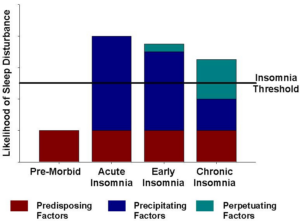
(Figure 1: adopted from Morin 2008)
Predisposing factors:
- anxiety
- depression
Precipitating factor:
- sudden change in life
- medication change
- injury
- schedule change
Perpetuating factors:
- poor sleep hygiene
- beliefs/thoughts/fears of sleeplessness