Get Supported and Get to Sleep!
Tips and Strategies for a Better Night’s Sleep
Continuing on in our blog series to enhance your sleep quality, this post focuses on sleep posture and positional supports. I hope this finds you resting more effectively after deploying some of the strategies detailed in our previous posts on improving your sleep hygiene and have come to appreciate how sleep deprivation can sustain your chronic aches and pains. How are these changes going? Do you have questions? We invite you to reach out to our team of experts to Discover your Potential!® or leave your questions as comments to these posts.Support Principles
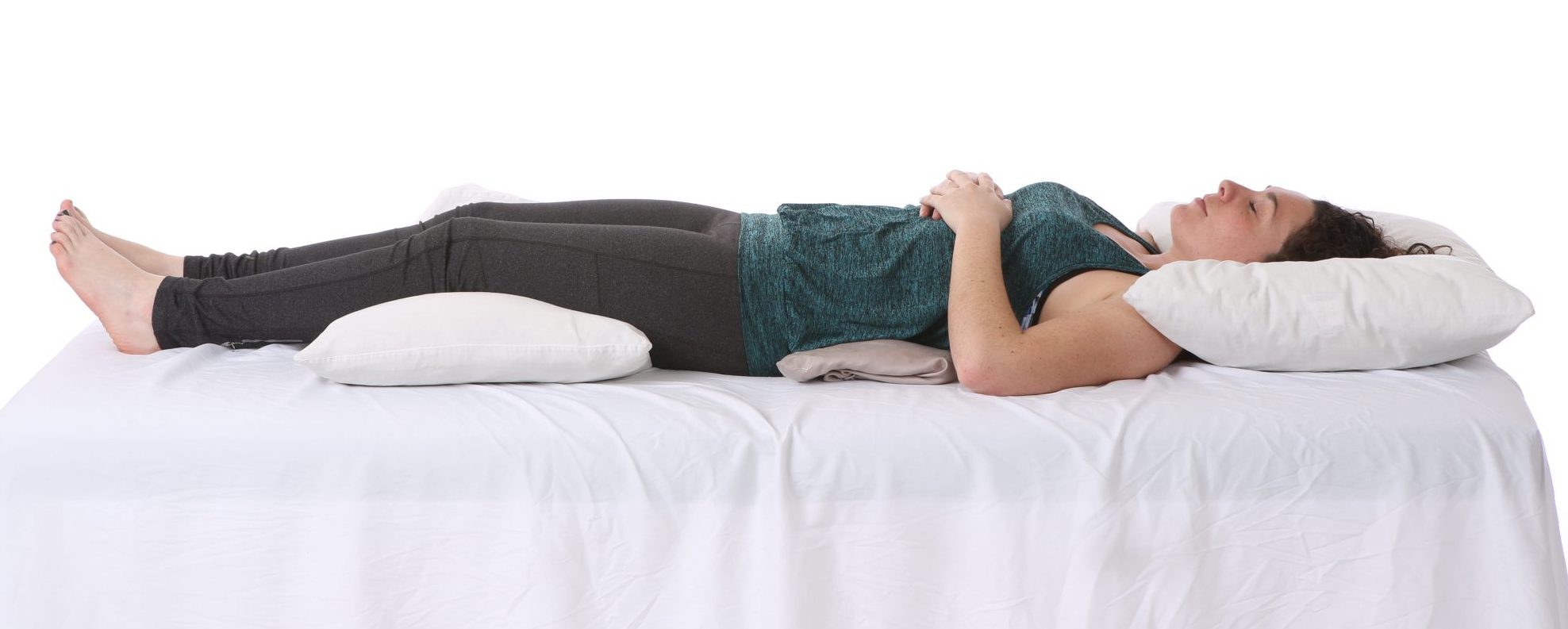
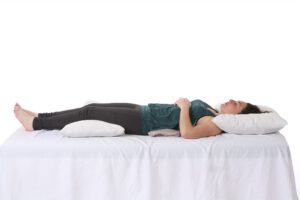
If you have pain that is keeping you from getting to sleep, staying asleep or you wake feeling stiff and sore, you would likely benefit from improving your body’s support during the night. Effective rest can only be found in a position that promotes comfort, which can be in a variety of positions including lying on your back, side, stomach, or reclining. A position of comfort will reduce your pain, improve your sleep duration, quality of sleep and improve your ability to come upright with less pain after resting. To discover what positions and supports that would be most beneficial for you, keep in mind the goal of supporting the body is to take tissues off tension or “unload” the symptomatic region. In order to effectively unload the symptomatic region, follow the principles of support which include:-
- Support the most central part of your body first, then support the extremities.
- Support all areas of suspension i.e “fill in all the air spaces” between your body and the surface of rest.
Will this help me? Test the Position, Don’t Guess!
The strategy we use to learn how various supports alter comfort in the position is called Kinesthetic Comparative Training (KCT) and was developed by Vicky Saliba Johnson, PT. It is a process of going from A (the first position) to B (the second position) and back to A to allow the brain to determine which position is really best for you. This ABA process should be used with all aspects of discovery for finding the best supports and position to reduce your pain. Let’s take a look at a few positions, the application of the support principles and exploration strategies to determine what supports work best for you.Side Lying
In sidelying, the first step is to experience the position as you would normally. Lie down on your side for a minute or two and scan your body for areas of suspension, pressure points or strain. There are multiple regions of the body that need support while side lying including the lower back, neck, and thighs. 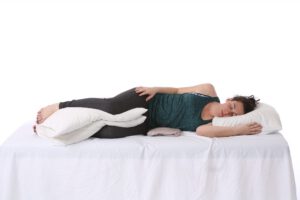
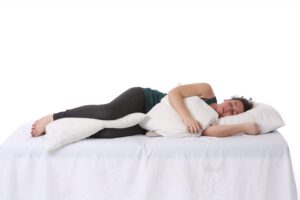 The hips would be considered the next most central part of the body, so let’s give them some attention! Everyone knows that supporting your legs takes the stress off the spine. But did you know that how you place the pillow can make a dramatic difference in the support? Try this: lie on your side and put a pillow just between your knees. Rest for a minute and then notice how your low back feels. Then, take the pillow and bring it very close to your hip, tucking it in close to the hip joint so the whole thigh is supported. Now lie there and see how your lumbar spine feels. Finally, go back to the pillow just between the legs.
Supporting the hips and lower back can go a long way to reduce stress to the neck as you take the kinks out of the system that would otherwise drive torque up to the neck. The neck is similar to the waist in that the shoulder is broad and the neck is narrow, especially while side lying. First, try to fluff up your pillow and pull it all the way down to the top of your shoulder to avoid any airspaces that might exist when the pillow is not in direct contact with the shoulder. If the pillow is too full or thick, it will push the neck into a side bent position. If this is the case, you need a smaller pillow that will keep the neck in a more neutral position. If the pillow is too thin and the neck shears down or side bends toward the bed. You can place a support under the pillow so that it fills in the space between the head and shoulder.
The hips would be considered the next most central part of the body, so let’s give them some attention! Everyone knows that supporting your legs takes the stress off the spine. But did you know that how you place the pillow can make a dramatic difference in the support? Try this: lie on your side and put a pillow just between your knees. Rest for a minute and then notice how your low back feels. Then, take the pillow and bring it very close to your hip, tucking it in close to the hip joint so the whole thigh is supported. Now lie there and see how your lumbar spine feels. Finally, go back to the pillow just between the legs.
Supporting the hips and lower back can go a long way to reduce stress to the neck as you take the kinks out of the system that would otherwise drive torque up to the neck. The neck is similar to the waist in that the shoulder is broad and the neck is narrow, especially while side lying. First, try to fluff up your pillow and pull it all the way down to the top of your shoulder to avoid any airspaces that might exist when the pillow is not in direct contact with the shoulder. If the pillow is too full or thick, it will push the neck into a side bent position. If this is the case, you need a smaller pillow that will keep the neck in a more neutral position. If the pillow is too thin and the neck shears down or side bends toward the bed. You can place a support under the pillow so that it fills in the space between the head and shoulder.
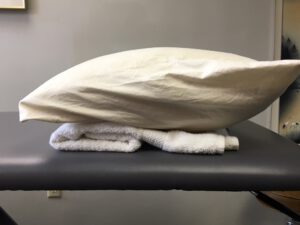 To create this support: take a small towel and fold it in ½ widthwise, and fold 1 edge of the towel 1-2 times creating thick end and longer flat end. Place the thick side under the pillow so that it will rest where the neck would be when you lie down. The long flat end should extend out under the pillow. Lie down and ensure the support is tucked all way to the top of shoulder. Rest minute or two determine if additional or less support is needed. See below picture.
Now that you have found the right amount of support for your body in sidelying, just lay there for several minutes. After you have experienced the position fully, start taking away supports and return to the position that you would normally assume and the difference in your perception of the position will be entirely different! Can you see how the lack of support is contributing to your pain? Most patients feel a significant difference and symptoms frequently stabilize as the areas that are overstretching are supported allowing letting tissues heal!
To create this support: take a small towel and fold it in ½ widthwise, and fold 1 edge of the towel 1-2 times creating thick end and longer flat end. Place the thick side under the pillow so that it will rest where the neck would be when you lie down. The long flat end should extend out under the pillow. Lie down and ensure the support is tucked all way to the top of shoulder. Rest minute or two determine if additional or less support is needed. See below picture.
Now that you have found the right amount of support for your body in sidelying, just lay there for several minutes. After you have experienced the position fully, start taking away supports and return to the position that you would normally assume and the difference in your perception of the position will be entirely different! Can you see how the lack of support is contributing to your pain? Most patients feel a significant difference and symptoms frequently stabilize as the areas that are overstretching are supported allowing letting tissues heal!
On Your Back
On Your Stomach
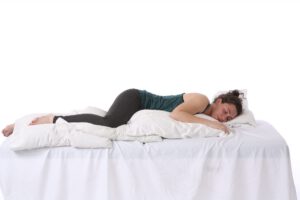
If you chose to sleep on your stomach, you are more likely to develop cervical spine problems and it is not a position we recommend that you sleep in. If you must sleep on your stomach, you can modify the position to take stress off the neck by only going part way onto your stomach. The example describes the position for right facing partial prone lying.